

MEXC is one of the most feature-rich crypto exchanges available today, but for new traders, it can feel overwhelming. The cluttered interface, multi-tier fee structure, and tightening KYC requirements in several regions all add friction before you even place your first trade.
If you are looking for a simpler starting point, this guide covers 5 beginner-friendly MEXC alternatives in 2026, each ranked on ease of use, fee transparency, and onboarding experience. If fast sign-up, clear spot fees, demo trading, copy trading, and no-KYC access for basic crypto trading matter to you, BYDFi is one option worth keeping in mind.
Why New Traders Look for a Simpler MEXC Alternative
MEXC is built for traders who already know what they are doing. That is not a criticism. It is just the reality of how the platform is designed.
For someone new to crypto, that design creates real problems.
The interface is overwhelming
When you log into MEXC for the first time, you are greeted with charts, order books, trading pairs, futures tabs, and multiple market views all at once. There is no simplified mode for beginners. Everything is visible from day one, and that can make simple crypto trading feel far more complicated than it needs to be.
KYC and regional restrictions add friction
MEXC has been tightening its KYC requirements in several regions. Users in the US, Canada, and parts of Europe may face access limitations or additional verification requirements depending on their location. For a new trader, dealing with regional restrictions before making a single trade is not a great start.
The fee structure is not straightforward
MEXC offers zero maker fees on spot trading, which sounds simple. But once you factor in futures fees, VIP tiers, withdrawal costs, and token-specific conditions, the full picture becomes harder to read. New traders often do not know what they will actually pay until after the trade.
Too many features, not enough guidance
MEXC offers futures, margin trading, staking, launchpad, ETF tokens, and more. For an experienced trader, that is an advantage. For someone just learning the basics, it is noise. Most beginners do not need 20 features. They need one clear path to buying and managing crypto.
These are the exact reasons why many new traders start looking for a simpler MEXC alternative, one that removes the friction and lets them focus on learning and trading without the confusion.
Best MEXC Alternatives in 2026
| Exchange | Ease of Use | Spot Fees | KYC Required | Best For |
| MEXC | Moderate | 0% maker / 0.05% taker | Yes (expanding) | Advanced traders, altcoin hunters |
| Coinbase | Very Easy | Varies by payment method | Yes | Absolute beginners, US and EU users |
| Kraken | Easy | Varies by trading mode | Yes | Security-focused beginners |
| Bybit | Easy to Moderate | 0.001 | Yes | Altcoin traders outside US and UK |
| KuCoin | Moderate | 0.001 | Partial | Altcoin access, global traders |
| BYDFi | Easy | 0.001 | No KYC | Fast sign-up, no-KYC traders |
1. Coinbase — Best for Absolute Beginners
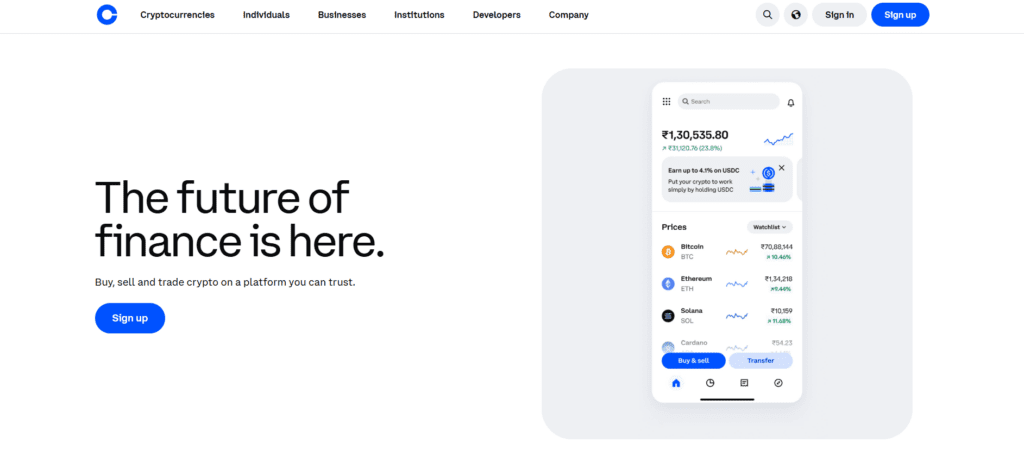
Best for: First-time buyers in the US, EU, or UK who value simplicity over low fees.
Coinbase is the most straightforward starting point for first-time crypto buyers. The interface is built around one action buying crypto with no order books, no futures tabs, and no clutter.
Key Features
- Supports major cryptocurrencies and a selection of altcoins
- Clean mobile and web app for first-time users
- Built-in education hub with crypto basics
- Staking and recurring buy options
- Available in 100+ countries
Fees
Coinbase’s fees are higher than MEXC, and that is the honest trade-off for its simplicity. The standard Coinbase platform charges a spread plus a flat fee that varies depending on transaction size, payment method, and region. For traders who want lower costs, Coinbase Advanced Trade offers significantly reduced fees that decrease further as trading volume grows. Fee details can vary, so it is worth checking Coinbase’s official fee page for the most current rates before trading.
For a beginner making small trades, the standard fees are acceptable. As you grow, Advanced Trade brings costs down.
Drawbacks
- Higher fees on the standard plan
- More limited altcoin selection compared with some advanced trading platforms
- Not available in all countries
2. Kraken — Best for Beginners Who Want Security + Simplicity
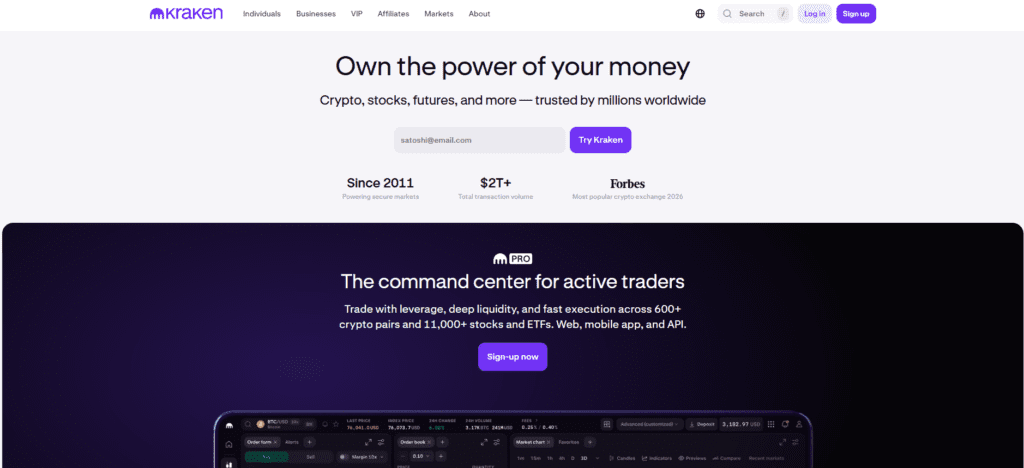
Best for: Beginners who prioritize security and want room to grow into advanced tools.
Kraken pairs beginner simplicity with one of the strongest security track records in crypto. Founded in 2011, it offers a clean beginner dashboard alongside Kraken Pro for when you are ready to trade more actively.
Key Features
- Broad crypto asset support across 190+ countries
- Separate beginner app and Kraken Pro
- Recurring buy and staking options
- 24/7 customer support via live chat and phone
- Quarterly Proof of Reserves published publicly
Fees
Kraken’s fees depend on which mode you use. The standard app offers an instant buy option with a convenience fee built in, while Kraken Pro provides lower fees for traders who are comfortable using an order book. Pro fees vary based on your 30-day trading volume, with rates decreasing as volume increases. For the most accurate and up-to-date fee information, it is recommended to check Kraken’s official fee schedule directly, as rates may vary by region and order type.
For a new trader making occasional purchases through the standard app, the convenience fee is acceptable. Once you are ready to trade more actively, switching to Kraken Pro brings costs down considerably.
Drawbacks
- Instant buy fee on the standard app is higher than MEXC’s spot fees
- Transition to Kraken Pro can be steep for complete beginners
- Not available in New York, Maine, and a few other restricted regions
3. Bybit — Best Simple Alternative for Altcoin Traders
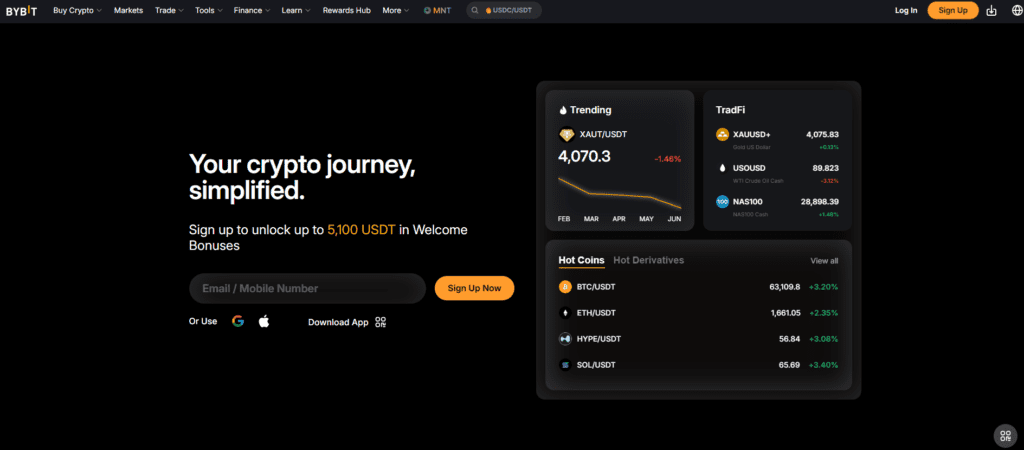
Best for: Traders outside the US, UK, and Canada who want altcoin access with beginner-friendly tools.
Bybit offers wide crypto market coverage with a cleaner interface than MEXC. Its copy trading and demo account features make it especially useful for beginners who want to learn before risking real funds.
Key Features
- Wide crypto market coverage across spot, futures, and options
- Copy trading and demo account for beginners
- Built-in bots and TradingView-powered charts
- Monthly Proof of Reserves
Fees
Bybit’s fee structure is one of its stronger points for cost-conscious traders.
Spot trading fees are 0.1%, and for derivatives trading, maker fees are 0.02% and taker fees are 0.055%. These rates are competitive and comparable to MEXC’s fee structure, making it a solid low fee crypto exchange option for altcoin traders who want to keep costs down.
Bybit also offers zero trading fees on select spot trading pairs, which adds further value for traders who focus on specific markets.
Drawbacks
- Not available in the US, UK, or Canada
- In February 2025, Bybit experienced a significant security breach, though the platform has since strengthened its security measures
- Limited direct fiat deposit options in many countries
4. KuCoin — Best for Altcoin Access Without the Overwhelm
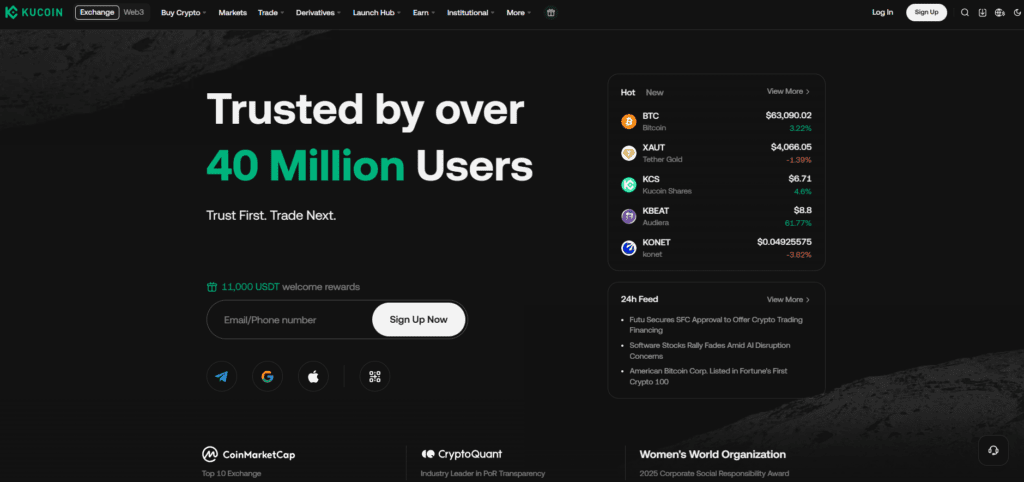
Best for: Global altcoin traders outside the US, Singapore, and mainland China who want competitive fees from day one.
KuCoin offers access to 700+ tokens including low-cap and early-stage altcoins, with a cleaner layout than MEXC and a competitive flat fee structure.
Key Features
- Broad crypto asset support including low-cap and emerging tokens
- Trading bot marketplace with one-click deployment
- Staking, futures, margin, and P2P marketplace
- Email-only registration for basic trading
Fees
KuCoin’s fee structure is one of the most competitive among the platforms in this list.
The base trading rate is 0.1% for both makers and takers, matching Binance and undercutting most competitors. Users can reduce fees further by holding KCS (KuCoin Shares), with a 20% discount when paying fees with KCS.
For futures trading, fees start at approximately 0.02% maker and 0.06% taker, with further reductions available through VIP levels and KCS benefits.
For a new trader focused on simple crypto trading with altcoins, the base 0.1% spot fee is straightforward, predictable, and easy to plan around.
Drawbacks
- Restricted in the US, China, Hong Kong, and Singapore
- No copy trading feature
- Full interface can still feel overwhelming for complete beginners
5. BYDFi— Best No-KYC Simple Alternative
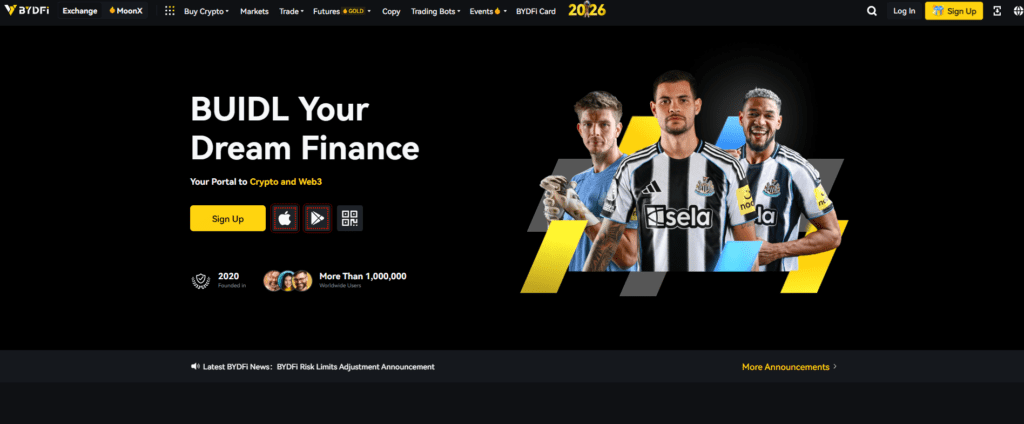
Best for: Traders who want fast sign-up without KYC, or those in regions where MEXC has regional access limitations or additional verification requirements.
BYDFi removes the biggest onboarding frustration with MEXC: identity verification. Sign up with an email, skip the passport upload, and start trading in under a minute.
Key Features
- Access to spot trading, perpetual contracts, and leverage trading across supported crypto markets, with leverage available up to 200x on selected contracts
- No KYC required for basic crypto deposits and trading
- Copy trading, grid bots, P2P marketplace, and fiat on/off ramps
- Demo account for practice trading
- MoonX tool for on-chain memecoin trading on Solana and BNB Chain
- 2FA, cold wallets, multi-signature technology, and 1:1 Proof of Reserves
Fees
BYDFi charges a flat 0.1% spot maker/taker fee, keeping costs clear and predictable from day one. Futures fees are available at lower rates for makers compared to takers. Crypto deposits are generally free, while fiat, card, and third-party payment costs may vary depending on region, asset, and payment provider. For the most current details, check BYDFi’s official fee page.
Drawbacks
- Non-KYC accounts have a daily withdrawal limit of 1 BTC
- Fiat deposits and withdrawals require identity verification
- Smaller brand recognition than Coinbase, Kraken, or KuCoin
- Perpetual contracts may be restricted in parts of the EU or UK
Conclusion
The right MEXC alternative depends on what matters most to you right now. Coinbase for the simplest start. Kraken for security and trust. Bybit for altcoins with beginner tools. KuCoin for token variety. BYDFi for no-KYC fast access. Each removes a different layer of friction that beginners typically run into on MEXC.
Frequently Asked Questions
Is MEXC good for beginners?
MEXC is designed for experienced traders. The interface, feature depth, and tightening KYC requirements in several regions make it a poor starting point for someone new to crypto.
Which MEXC alternative has the lowest fees?
KuCoin, Bybit, and BYDFi all charge a flat 0.10% spot fee. Coinbase is the most expensive on the standard plan but more competitive on Advanced Trade. Kraken’s rates vary by trading mode and volume.
Can I use these exchanges without KYC?
BYDFi is the only platform on this list that allows trading without identity verification, with a 1 BTC daily withdrawal limit for non-verified accounts. KuCoin allows basic access without full KYC but limits withdrawals until verification is complete.
Which exchange is easiest for a first-time buyer?
Coinbase is the easiest. It is built around a simple Buy/Sell flow with no order books or trading modes to navigate. Kraken is a close second with lower fees and strong security.